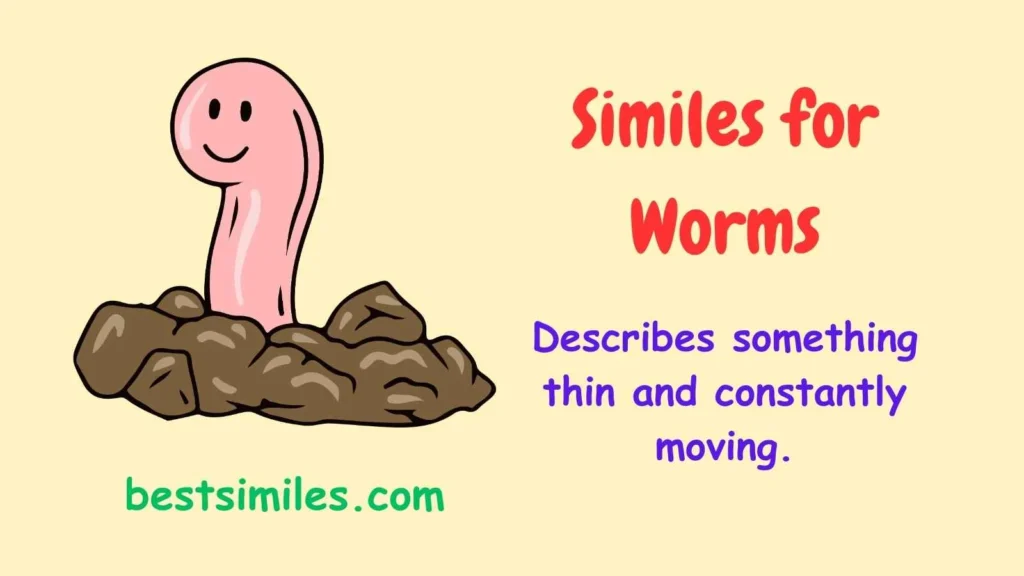
Similes for worms help writers describe movement, softness, and earthbound life in a vivid and memorable way.
These comparisons turn a simple creature into a powerful literary image used in poems, stories, and descriptive writing. Worms symbolize humility, resilience, nature, soil, and quiet strength, making them useful in creative and educational contexts.
By using similes for worms, readers can improve imagery, sensory language, and figurative expression without sounding forced or unnatural. Such similes are popular in school assignments, poetry analysis, creative essays, and vocabulary building, especially for learners who want clarity with creativity.
What Is a Simile?
A simile is a figure of speech that compares two different things using the words “like” or “as.”
It helps make descriptions clearer, more vivid, and easier to imagine.
Simile for Worms Like a Wiggling Thread
Meaning: Describes something thin and constantly moving.
Definition: A comparison highlighting flexible and twisting motion.
Examples:
- The worm moved like a wiggling thread across the soil.
- His fingers shook like a wiggling thread in the cold.
Simile for Worms Like a Living String
Meaning: Emphasizes long, narrow shape with life.
Definition: Comparing worms to animated strings.
Examples:
- The worm looked like a living string after rain.
- The cable lay like a living string on the floor.
Simile for Worms Like Slippery Noodles
Meaning: Focuses on smooth and slippery texture.
Definition: A simile highlighting slick movement.
Examples:
- Worms slid like slippery noodles in the mud.
- His hands felt like slippery noodles with sweat.
Simile for Worms Like Tiny Snakes
Meaning: Shows resemblance in shape and movement.
Definition: Comparing worms to miniature snakes.
Examples:
- Worms crawled like tiny snakes after the storm.
- The wires twisted like tiny snakes behind the desk.
Simile for Worms Like Soft Rubber Tubes
Meaning: Indicates flexibility and softness.
Definition: A simile comparing texture and bendability.
Examples:
- The worm felt like a soft rubber tube.
- The hose bent like a soft rubber tube.
Simile for Worms Like Dancing Threads
Meaning: Highlights lively and rhythmic movement.
Definition: Comparing worms’ motion to dancing threads.
Examples:
- Worms danced like threads in wet soil.
- The ribbons moved like dancing threads in wind.
Simile for Worms Like Squirming Ribbons
Meaning: Focuses on twisting and curling action.
Definition: A comparison showing continuous movement.
Examples:
- Worms lay like squirming ribbons on the ground.
- The cords looked like squirming ribbons.
Simile for Worms Like Living Spaghetti
Meaning: Describes long and tangled appearance.
Definition: A fun simile comparing worms to pasta.
Examples:
- The worms looked like living spaghetti.
- The cables were tangled like living spaghetti.
Simile for Worms Like Slithering Shadows
Meaning: Shows quiet and smooth motion.
Definition: Comparing worms’ movement to shadows.
Examples:
- Worms moved like slithering shadows underground.
- His hands crept like slithering shadows.
Simile for Worms Like Earth’s Veins
Meaning: Symbolizes worms as lifelines of soil.
Definition: A metaphorical simile showing importance.
Examples:
- Worms spread like earth’s veins.
- Roots stretched like earth’s veins.
Simile for Worms Like Bending Wires
Meaning: Shows flexibility and curve.
Definition: Comparing worms’ shape to wires.
Examples:
- Worms curved like bending wires.
- The metal twisted like bending wires.
Simile for Worms Like Crawling Shoelaces
Meaning: Describes thin, twisting movement.
Definition: A playful simile for shape and motion.
Examples:
- Worms crawled like shoelaces on soil.
- The ropes lay like crawling shoelaces.
Simile for Worms Like Wet Threads
Meaning: Focuses on moisture and thinness.
Definition: A texture-based simile.
Examples:
- Worms felt like wet threads.
- Her hair stuck like wet threads.
Simile for Worms Like Lazy Snakes
Meaning: Slow and relaxed movement.
Definition: A simile highlighting pace.
Examples:
- Worms moved like lazy snakes.
- The river flowed like a lazy snake.
Simile for Worms Like Muddy Strings
Meaning: Shows dirt-covered appearance.
Definition: Comparing worms to dirty strings.
Examples:
- Worms lay like muddy strings.
- The cables looked like muddy strings.
Simile for Worms Like Twisting Roots
Meaning: Emphasizes underground life.
Definition: A nature-based simile.
Examples:
- Worms curled like twisting roots.
- Thoughts tangled like twisting roots.
Simile for Worms Like Living Cords
Meaning: Highlights length and movement.
Definition: Comparing worms to cords with life.
Examples:
- Worms stretched like living cords.
- Muscles tightened like living cords.
Simile for Worms Like Shiny Noodles
Meaning: Describes glossy appearance.
Definition: A visual simile.
Examples:
- Worms gleamed like shiny noodles.
- The wires shone like shiny noodles.
Simile for Worms Like Crawling Lines
Meaning: Focuses on shape and direction.
Definition: A minimalistic simile.
Examples:
- Worms looked like crawling lines.
- Ants moved like crawling lines.
Simile for Worms Like Silent Sliders
Meaning: Quiet and smooth movement.
Definition: A motion-based simile.
Examples:
- Worms slid like silent sliders.
- Skaters moved like silent sliders.
Simile for Worms Like Soft Ropes
Meaning: Indicates thickness and flexibility.
Definition: A tactile simile.
Examples:
- Worms felt like soft ropes.
- The scarf lay like soft ropes.
Simile for Worms Like Winding Strings
Meaning: Shows continuous curves.
Definition: Comparing worms to coiling strings.
Examples:
- Worms wound like strings.
- The road curved like winding strings.
Simile for Worms Like Underground Dancers
Meaning: Lively unseen movement.
Definition: A creative simile for activity.
Examples:
- Worms moved like underground dancers.
- Thoughts danced like underground dancers.
Simile for Worms Like Slippery Lines
Meaning: Smooth and straight movement.
Definition: A simple descriptive simile.
Examples:
- Worms slid like slippery lines.
- Fish moved like slippery lines.
Simile for Worms Like Living Threads of Soil
Meaning: Shows connection with earth.
Definition: A poetic simile.
Examples:
- Worms were like living threads of soil.
- Roots formed living threads of soil.
Simile for Worms Like Curled Cables
Meaning: Emphasizes coiling shape.
Definition: A modern simile.
Examples:
- Worms lay like curled cables.
- Hoses rested like curled cables.
Simile for Worms Like Slow Rivers
Meaning: Calm, steady movement.
Definition: Comparing motion speed.
Examples:
- Worms flowed like slow rivers.
- Time passed like a slow river.
Simile for Worms Like Hidden Highways
Meaning: Symbolizes underground paths.
Definition: A functional simile.
Examples:
- Worms formed hidden highways in soil.
- Thoughts became hidden highways.
Simile for Worms Like Gentle Waves
Meaning: Smooth rhythmic motion.
Definition: A fluid-motion simile.
Examples:
- Worms moved like gentle waves.
- Curtains flowed like gentle waves.
Write Creatively With Worm Similes
Using similes creatively can transform simple writing into memorable content. You can:
- Add imagery to poems and songs
- Make nature descriptions more vivid
- Improve storytelling depth
- Enhance school essays and creative assignments
Try placing similes where movement, texture, or emotion needs clarity.
FAQs
What Are Similes for Worms Used For?
They are used to describe movement, shape, softness, and underground life in writing.
Are Similes for Worms Useful in Poetry?
Yes, they add imagery, symbolism, and rhythm to poems.
Can Worm Similes Be Used for Kids’ Writing?
Absolutely. They are simple, visual, and fun for young readers.
Why Are Worms Common in Nature Writing?
Worms represent life, soil health, and natural cycles.
How Do Similes Improve Writing?
They make descriptions clearer, more engaging, and easier to imagine.
Conclusion
Similes bring words to life, and similes for worms add creativity, depth, and vivid imagery to writing.
From poetry to essays, these comparisons help readers visualize movement and texture clearly.
Use these similes confidently to enrich your content, impress readers, and make your writing more engaging and memorable. Bookmark this list and return whenever inspiration is needed.

Jeson is a passionate wordsmith and language enthusiast at BestSimiles.com, dedicated to exploring the beauty of similes and creative expressions. With a knack for making language fun and relatable, he inspires readers to see everyday life through vivid comparisons. Jeson’s insights blend clarity, creativity, and practical tips to help everyone elevate their writing.