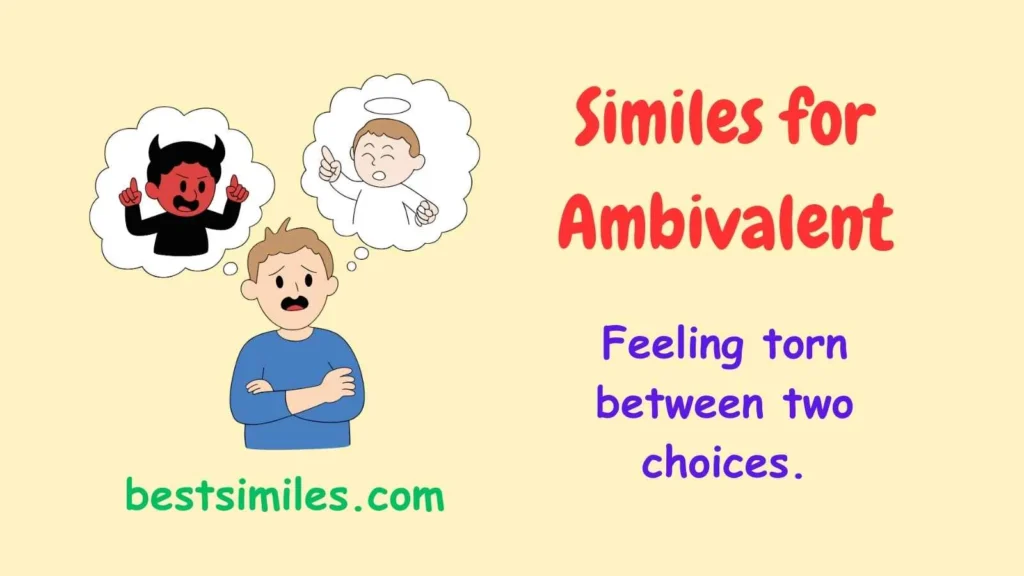
Similes for Ambivalent capture the complex feelings of uncertainty and mixed emotions in a way that resonates deeply with readers.
Just as a storm can be both beautiful and destructive, ambivalence reflects the push and pull of conflicting thoughts. Using the right similes allows writers, speakers, and thinkers to express hesitation, doubt, or duality with clarity and flair.
From comparing emotions to a tug-of-war between heart and mind, to describing choices like walking on a foggy path where directions are unclear, these similes bring abstract feelings to vivid life.
Whether in creative writing, storytelling, or personal reflection, understanding and employing powerful comparisons helps your audience connect on a deeper emotional level, making your words more memorable and impactful.
Quick Definition of a Simile
A simile is a figure of speech that compares two different things using the words “like” or “as”. It helps the reader visualize or feel an idea more clearly.
1. Like a coin flipping in the air
Meaning: Feeling torn between two choices.
Definition: Represents indecision or uncertainty.
Example sentences:
- She felt like a coin flipping in the air, unsure which path to take.
- His heart was like a coin flipping in the air, swinging between hope and fear.
2. Like walking on thin ice
Meaning: Feeling unsure and cautious.
Definition: Indicates vulnerability and hesitation.
Example sentences:
- Making that decision felt like walking on thin ice.
- He approached the topic like walking on thin ice, not wanting to offend.
3. Like standing at a crossroads
Meaning: Confused about which choice to make.
Definition: Represents a moment of indecision.
Example sentences:
- She felt like standing at a crossroads, torn between two careers.
- His mind was like standing at a crossroads, unsure which direction to follow.
4. Like balancing on a tightrope
Meaning: Struggling to maintain stability in a difficult situation.
Definition: Reflects careful hesitation and uncertainty.
Example sentences:
- He felt like balancing on a tightrope, trying to please everyone.
- Making the announcement was like balancing on a tightrope, fraught with tension.
5. Like clouds in a storm
Meaning: Emotionally unsettled or confused.
Definition: Represents fluctuating emotions.
Example sentences:
- Her feelings were like clouds in a storm, shifting unpredictably.
- He felt like clouds in a storm, torn between anger and forgiveness.
6. Like a pendulum swinging
Meaning: Alternating between two emotions or choices.
Definition: Symbolizes indecisiveness and change.
Example sentences:
- His mood was like a pendulum swinging, from excitement to doubt.
- She was like a pendulum swinging, unsure whether to stay or leave.
7. Like a ship in fog
Meaning: Feeling lost or uncertain about the future.
Definition: Represents confusion and lack of clarity.
Example sentences:
- He felt like a ship in fog, unable to see the next step.
- Her decisions were like a ship in fog, drifting without direction.
8. Like a flickering candle
Meaning: Unsteady emotions or thoughts.
Definition: Suggests wavering feelings.
Example sentences:
- His confidence was like a flickering candle, unstable and weak.
- She felt like a flickering candle, unsure if her courage would last.
9. Like a seesaw in motion
Meaning: Experiencing alternating emotions.
Definition: Illustrates emotional ups and downs.
Example sentences:
- Their relationship was like a seesaw in motion, full of highs and lows.
- He felt like a seesaw in motion, torn between love and doubt.
10. Like a bird between two branches
Meaning: Caught between two choices.
Definition: Symbolizes indecision and hesitation.
Example sentences:
- She felt like a bird between two branches, unsure where to land.
- His mind was like a bird between two branches, unable to settle.
11. Like twilight between day and night
Meaning: Feeling in-between, not certain.
Definition: Represents ambiguity or mixed feelings.
Example sentences:
- His emotions were like twilight between day and night, neither happy nor sad.
- She felt like twilight between day and night, stuck in uncertainty.
12. Like a candle in the wind
Meaning: Fragile and uncertain.
Definition: Indicates vulnerability and ambivalence.
Example sentences:
- His resolve was like a candle in the wind, flickering with doubt.
- She felt like a candle in the wind, unsure if she could stand firm.
13. Like a river splitting into streams
Meaning: Pulled in different directions.
Definition: Suggests indecision and diverging thoughts.
Example sentences:
- Her mind was like a river splitting into streams, torn between options.
- He felt like a river splitting into streams, unsure which path to follow.
14. Like a shadow in sunlight
Meaning: Unclear or contradictory feelings.
Definition: Represents mixed emotions.
Example sentences:
- His intentions were like a shadow in sunlight, hard to interpret.
- She felt like a shadow in sunlight, both present and absent in her thoughts.
15. Like a leaf in the wind
Meaning: Feeling unsure or carried by circumstances.
Definition: Symbolizes lack of control and indecision.
Example sentences:
- He drifted like a leaf in the wind, uncertain where life would take him.
- Her thoughts were like a leaf in the wind, constantly changing.
16. Like a flame in a storm
Meaning: Fragile but persistent emotions.
Definition: Suggests vulnerability amidst chaos.
Example sentences:
- His courage was like a flame in a storm, flickering but enduring.
- She felt like a flame in a storm, trying to stay strong despite fear.
17. Like a tide coming and going
Meaning: Emotions that fluctuate.
Definition: Represents constant change in feelings.
Example sentences:
- His enthusiasm was like a tide coming and going, unpredictable.
- Her mood was like a tide coming and going, shifting every moment.
18. Like fog on a mirror
Meaning: Confused or unclear thinking.
Definition: Symbolizes difficulty in seeing things clearly.
Example sentences:
- His thoughts were like fog on a mirror, blurred and confusing.
- She felt like fog on a mirror, unable to see a clear path.
19. Like a tightrope walker in a storm
Meaning: Navigating uncertainty carefully.
Definition: Suggests precarious balance and caution.
Example sentences:
- Making that choice was like a tightrope walker in a storm, tense and risky.
- He moved forward like a tightrope walker in a storm, step by step.
20. Like a cat on a hot tin roof
Meaning: Nervous and indecisive.
Definition: Represents restlessness and hesitation.
Example sentences:
- She felt like a cat on a hot tin roof, unsure what to do next.
- His mind raced like a cat on a hot tin roof, full of doubt.
21. Like ice melting in the sun
Meaning: Gradually changing feelings.
Definition: Suggests shifting emotions over time.
Example sentences:
- His anger was like ice melting in the sun, slowly fading.
- She felt like ice melting in the sun, emotions softening with time.
22. Like a stormy sea
Meaning: Conflicted emotions.
Definition: Represents turbulence inside.
Example sentences:
- His heart was like a stormy sea, restless and unpredictable.
- She felt like a stormy sea, unsure how to calm herself.
23. Like smoke in the air
Meaning: Elusive or hard-to-grasp feelings.
Definition: Symbolizes vagueness and uncertainty.
Example sentences:
- His thoughts were like smoke in the air, fleeting and unclear.
- She felt like smoke in the air, intangible and drifting.
24. Like a mirror reflecting multiple faces
Meaning: Conflicted identity or emotions.
Definition: Suggests ambivalence and self-questioning.
Example sentences:
- She was like a mirror reflecting multiple faces, unsure of herself.
- His personality felt like a mirror reflecting multiple faces, contradictory and layered.
25. Like shadows in a flickering light
Meaning: Unstable or inconsistent emotions.
Definition: Represents fleeting thoughts and feelings.
Example sentences:
- Her mood was like shadows in a flickering light, unpredictable.
- He felt like shadows in a flickering light, unsure of his own desires.
26. Like waves crashing against rocks
Meaning: Conflicted emotions hitting obstacles.
Definition: Suggests tension and inner struggle.
Example sentences:
- His feelings were like waves crashing against rocks, turbulent and unresolved.
- She felt like waves crashing against rocks, constantly battling her emotions.
27. Like fog over a valley
Meaning: Unclear perspective or indecision.
Definition: Symbolizes uncertainty and obscured clarity.
Example sentences:
- Her future seemed like fog over a valley, hidden and uncertain.
- He felt like fog over a valley, lost in indecision.
28. Like a bird caught in a cage
Meaning: Feeling trapped between choices.
Definition: Represents restriction and indecision.
Example sentences:
- She was like a bird caught in a cage, unable to make a decision.
- His mind felt like a bird caught in a cage, longing for freedom.
29. Like a pendulum of doubt
Meaning: Swinging between certainty and uncertainty.
Definition: Indicates inner conflict and ambivalence.
Example sentences:
- He was like a pendulum of doubt, never settling on a choice.
- She felt like a pendulum of doubt, torn between yes and no.
30. Like a puzzle missing pieces
Meaning: Feeling incomplete or uncertain.
Definition: Suggests confusion and inner conflict.
Example sentences:
- Her heart felt like a puzzle missing pieces, incomplete and uncertain.
- He felt like a puzzle missing pieces, struggling to find clarity.
Creative Ways to Use Similes in Writing
- Poems: Use similes to create vivid imagery and express inner conflict.
- Stories: Show character emotions without directly stating them.
- Songs: Convey complex feelings in a few expressive lines.
- Essays: Make arguments more relatable by comparing abstract ideas to real-life objects.
- Journaling: Reflect on personal emotions using creative comparisons.
FAQs About Similes for Ambivalent
What does “ambivalent” mean?
Ambivalent means having mixed or contradictory feelings about something.
Why use similes for ambivalence?
Similes help describe complex emotions in a clear and relatable way.
Can I use these similes in academic writing?
Yes, when appropriate. They make descriptions vivid but keep them formal.
How many similes should I use in a poem or story?
Use as many as needed for clarity, but avoid overloading; 1–3 per paragraph works well.
Are these similes suitable for songs?
Absolutely! They can make lyrics more emotional and relatable.
Conclusion
Exploring similes for ambivalent helps you express mixed emotions clearly and creatively.
From poems to essays, these comparisons make your writing more vivid and relatable.
Start using them today and watch your words resonate deeper with your audience. Ambivalence has never been easier to describe!

Michel is a passionate language enthusiast and the creative mind behind bestsimiles.com, dedicated to exploring the beauty of words and expressions. With a deep love for literary arts, he brings readers unique insights and engaging content on similes and figurative language. His work inspires writers and language lovers to think creatively and express themselves more vividly.