Similes and Metaphors for Stress reveal how deeply our emotions can twist, tighten, and overwhelm the human mind.
Stress is often like a storm brewing inside, unsettling our peace and clarity. Through powerful comparisons, we can visualize emotions that words alone fail to express — whether it’s pressure building like a volcano or anxiety crawling like shadows in the night.
These expressive figures of speech not only make language richer but also help us understand and manage tension in relatable ways. Exploring such similes and metaphors allows readers to see how creativity and emotion intertwine, transforming ordinary thoughts into vivid imagery that captures the essence of mental strain.
Quick Definition of a Simile
A simile is a figure of speech that compares two unlike things using “like” or “as” to make descriptions vivid and relatable.
For example: “Life is like a rollercoaster.”
It helps readers visualize emotions, objects, or experiences in a fresh, imaginative way.
Similes and Metaphors for Stress
Below are 30 powerful similes and metaphors for stress, each with a short meaning, definition, and examples to help you understand and use them effectively.
1. Stress is like a tightrope walk.
Meaning: It shows the need for balance and focus in stressful times.
Definition: Comparing stress to walking a tightrope to highlight precision and risk.
Examples:
- Handling work deadlines feels like walking a tightrope.
- Life under pressure can feel like balancing on a thin wire.
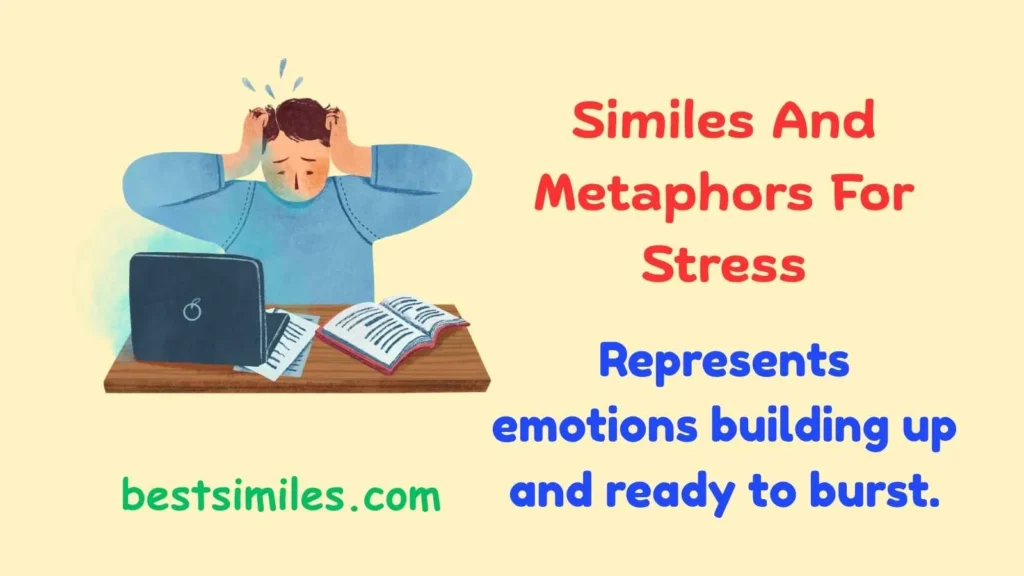
2. Stress is like a storm brewing inside.
Meaning: Represents emotions building up and ready to burst.
Definition: Compares inner turmoil to a storm forming in the sky.
Examples:
- Before the exam, a storm of stress brewed within me.
- Her mind was a sky filled with thunderclouds of worry.
3. Stress is like carrying a heavy backpack.
Meaning: Describes emotional burdens weighing a person down.
Definition: Compares stress to physical weight on one’s shoulders.
Examples:
- He carried his stress like a heavy backpack everywhere he went.
- Stress feels like extra weight you can’t put down.
4. Stress is like being trapped in quicksand.
Meaning: The more you struggle, the worse it gets.
Definition: Compares stress to quicksand that deepens with resistance.
Examples:
- I felt like I was sinking deeper into quicksand with every problem.
- Stress pulls you down when you try too hard to escape it.
5. Stress is like a ticking time bomb.
Meaning: It suggests pressure building toward an explosive outburst.
Definition: Compares stress to a time bomb ready to explode under pressure.
Examples:
- His unspoken worries were a ticking time bomb.
- The pressure of exams felt like a countdown to an explosion.
6. Stress is like a knot in the stomach.
Meaning: Expresses physical discomfort caused by anxiety.
Definition: Compares emotional tension to a tight knot inside.
Examples:
- Every time she spoke in public, a knot formed in her stomach.
- His stress twisted like a rope inside him.
7. Stress is like a dark cloud overhead.
Meaning: Represents a gloomy, constant presence.
Definition: Compares stress to a dark cloud that blocks joy.
Examples:
- Wherever she went, a cloud of worry followed.
- Stress hung over him like a storm about to burst.
8. Stress is like a hamster on a wheel.
Meaning: Reflects repetitive worry without progress.
Definition: Compares the mind under stress to a hamster endlessly running in circles.
Examples:
- My thoughts keep spinning like a hamster on a wheel.
- Stress makes me run without moving forward.
9. Stress is like boiling water.
Meaning: Symbolizes pressure building until it overflows.
Definition: Compares emotional strain to water that boils over with heat.
Examples:
- Her patience boiled away under stress.
- He was like a pot ready to spill over.
10. Stress is like a web of wires.
Meaning: Represents a tangled, confusing situation.
Definition: Compares stress to an intricate, messy web.
Examples:
- My mind feels like tangled wires of stress.
- She was caught in the web of her own worries.
11. Stress is like a volcano ready to erupt.
Meaning: Suggests hidden anger or pressure about to burst out.
Definition: Compares bottled-up tension to magma beneath a volcano.
Examples:
- His stress erupted like a volcano during the meeting.
- You could see the lava of anger beneath her calm face.
12. Stress is like a caged bird.
Meaning: Represents feeling trapped and restless.
Definition: Compares emotional confinement to a bird in a cage.
Examples:
- My mind flutters like a trapped bird under stress.
- He longed for freedom from his stressful cage.
13. Stress is like walking through fire.
Meaning: Describes pain and endurance.
Definition: Compares difficult experiences to enduring flames.
Examples:
- Working two jobs felt like walking through fire.
- Stress burned her from the inside out.
14. Stress is like static noise.
Meaning: Represents mental clutter and confusion.
Definition: Compares stress to radio static that blocks clarity.
Examples:
- His mind buzzed with the static of stress.
- She couldn’t focus through the noise in her head.
15. Stress is like a shadow that never leaves.
Meaning: Symbolizes constant presence.
Definition: Compares stress to an unshakable shadow.
Examples:
- No matter where I go, stress follows me like a shadow.
- Her shadow of stress darkened every happy moment.
16. Stress is like glass cracking under pressure.
Meaning: Represents fragility and breaking points.
Definition: Compares stress to cracks forming in glass.
Examples:
- His patience cracked like glass under pressure.
- One more problem and she would shatter completely.
17. Stress is like an overfilled balloon.
Meaning: Suggests tension ready to burst.
Definition: Compares emotional buildup to a balloon stretched too far.
Examples:
- He felt like a balloon about to pop.
- Too much stress can make anyone explode.
18. Stress is like rust on the soul.
Meaning: Symbolizes slow emotional decay.
Definition: Compares stress to rust that eats away over time.
Examples:
- Stress corrodes peace like rust on metal.
- Unchecked stress dulls the shine of happiness.
19. Stress is like waves crashing on the shore.
Meaning: Represents continuous cycles of tension.
Definition: Compares recurring stress to ocean waves.
Examples:
- Stress comes and goes like waves on the sand.
- Every new problem felt like another crashing wave.
20. Stress is like a maze with no exit.
Meaning: Describes confusion and helplessness.
Definition: Compares mental struggle to being lost in a maze.
Examples:
- He wandered through the maze of his stress.
- It felt impossible to find the way out.
21. Stress is like juggling too many balls.
Meaning: Symbolizes trying to manage too many tasks.
Definition: Compares stress to juggling without dropping anything.
Examples:
- She’s juggling stress from work and home.
- Life feels like a circus act sometimes.
22. Stress is like being underwater.
Meaning: Expresses suffocation and heaviness.
Definition: Compares stress to drowning or struggling to breathe.
Examples:
- He felt submerged in the sea of deadlines.
- Stress kept her gasping for emotional air.
23. Stress is like a candle burning at both ends.
Meaning: Represents exhaustion and overwork.
Definition: Compares energy depletion to a candle consuming itself.
Examples:
- She’s burning her candle at both ends.
- Stress eats away your light too fast.
24. Stress is like tangled earphones.
Meaning: Suggests everyday frustration.
Definition: Compares messy situations to tangled cords.
Examples:
- My plans got tangled like old earphones.
- Stress knots up everything simple.
25. Stress is like a broken compass.
Meaning: Symbolizes confusion and lack of direction.
Definition: Compares stress to losing sense of where to go.
Examples:
- Under stress, I can’t find my north.
- A broken compass can’t guide a worried mind.
26. Stress is like a roaring train.
Meaning: Represents unstoppable momentum.
Definition: Compares stress to a train speeding uncontrollably.
Examples:
- Her thoughts rushed like a roaring train.
- He couldn’t stop the speeding engine of his stress.
27. Stress is like a foggy morning.
Meaning: Expresses confusion and unclear thoughts.
Definition: Compares stress to fog blocking vision.
Examples:
- His mind was foggy with stress.
- She couldn’t see her way through the haze.
28. Stress is like a thunderstorm in the brain.
Meaning: Represents chaos and overthinking.
Definition: Compares mental noise to lightning and thunder.
Examples:
- Thoughts clashed like thunder in his head.
- Her stress struck like lightning bolts.
29. Stress is like an overpacked suitcase.
Meaning: Symbolizes carrying too many burdens.
Definition: Compares mental load to stuffing things beyond capacity.
Examples:
- Her mind was an overpacked suitcase of worries.
- Stress made everything feel too heavy to close.
30. Stress is like a marathon with no finish line.
Meaning: Expresses endless struggle and fatigue.
Definition: Compares long-term stress to a race without rest.
Examples:
- He’s been running on stress for years.
- Life shouldn’t feel like a never-ending marathon.
How to Use These Similes and Metaphors in Creative Writing
You can use similes and metaphors for stress to make your writing emotional and vivid. Here’s how:
- In poems: Use them to reflect emotional turbulence or inner struggles.
Example: “My thoughts spin like a hamster on a wheel.” - In stories: Describe how a character feels under pressure.
Example: “She felt like glass cracking under the weight of worry.” - In songs: Add emotional rhythm to lyrics.
Example: “I’m a candle burning on both ends tonight.” - In essays: Express deep analysis of stress or anxiety with relatable imagery.
✨ Tip: Mix metaphors and similes for greater emotional depth. Too many in one paragraph, however, can overwhelm the reader.
FAQs
What is a simile for stress?
A simile for stress compares stress to something relatable, like “Stress is like a storm brewing.”
What is a metaphor for feeling overwhelmed?
A common metaphor is “I’m drowning in stress,” showing the sense of suffocation.
How do similes and metaphors help describe emotions?
They make abstract emotions visible and relatable by linking them to physical or natural elements.
Can I use stress metaphors in academic writing?
Yes, but sparingly — they add depth in essays or reflections but shouldn’t replace clear explanations.
What’s the difference between a simile and a metaphor?
A simile uses “like” or “as” (e.g., “Stress is like fire.”)
A metaphor states it directly (e.g., “Stress is fire.”)
Conclusion
Similes and metaphors for stress help turn feelings into vivid imagery that anyone can relate to.
They transform pressure into poetry, worry into words, and tension into truth.
So next time you feel overwhelmed, try expressing it creatively — because sometimes, the best relief comes from finding the right words.